
Smart Marketing vs. Traditional Marketing: Which Strategy Wins in the Digital Era?
Introduction
We live in an era where the world is digitizing at an incredible pace. From the moment we wake up until we go to sleep, smartphones and the internet have become inseparable parts of our lives. This shift has created a massive revolution in the business world. In the past, if a business owner wanted to reach their audience, they relied heavily on newspaper ads and TV commercials. Today, the scenario is entirely different.
As an entrepreneur, deciding on your marketing strategy is one of the most critical decisions you will make. Should you stick with the time-tested “Traditional Marketing” or embrace the data-driven “Smart Marketing” (Digital Marketing)? This blog explores which strategy truly wins in the modern digital era.
What is Traditional Marketing?
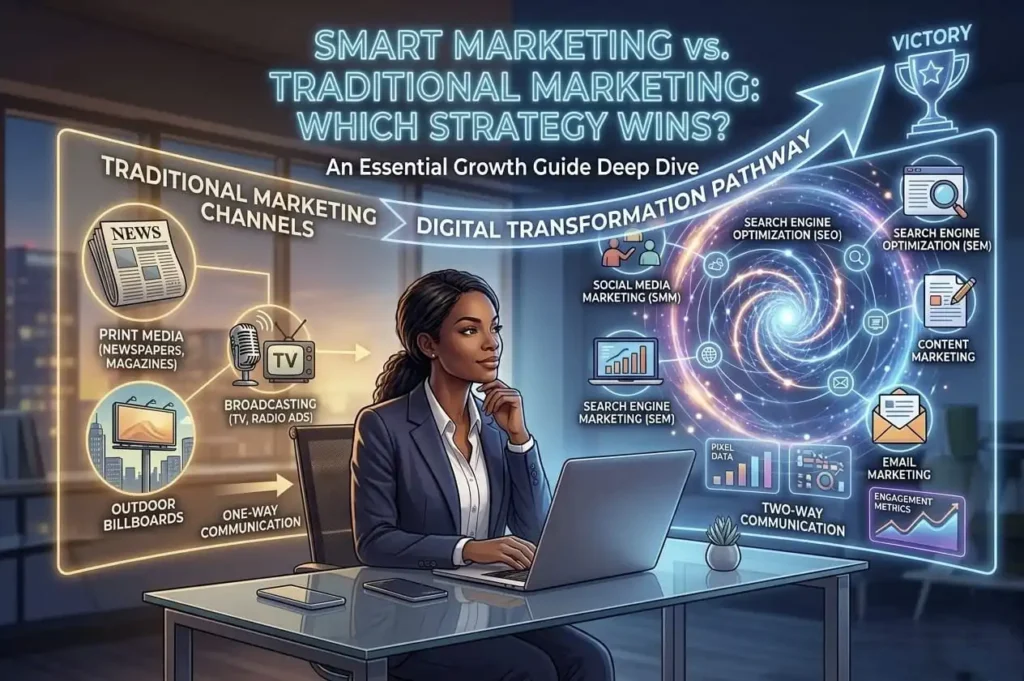
Conventional marketing encompasses all promotional strategies that do not rely on the internet.”. This involves reaching out to customers through physical mediums that have been used successfully for decades. In this method, information is delivered to the consumer through a physical or broadcast medium.
Key Traditional Marketing Channels:
Print Media: Advertisements in newspapers and magazines.
Billboards: Large outdoor advertising boards placed in high-traffic areas or roadsides.
Broadcasting: TV and Radio commercials played during shows or news.
Direct Mail: Sending physical flyers, brochures, or catalogs directly to a person’s home.
Telemarketing: Reaching out to potential customers via direct phone calls.
The Nature of Traditional Marketing: It is generally a “one-way communication” model. The brand delivers a message, and the consumer consumes it. There is very little room for immediate interaction, feedback, or questioning from the customer’s side.
What is Smart Marketing (Digital Marketing)?
Smart Marketing involves using the internet and digital technology to market products and services. It is called “Smart” because it isn’t just about shouting your message to a crowd; it is about using data to be intelligent, precise, and personalized.
Key Smart Marketing Channels:
Social Media Marketing (SMM): Leveraging popular networks such as Facebook, Instagram, and LinkedIn to promote your brand
Search Engine Optimization (SEO): Getting your website to the top of Google search results.
Search Engine Marketing (SEM): Using paid ads on Google (Pay-Per-Click).
Content Marketing: Attracting customers through helpful blogs, videos, and podcasts.
Email Marketing: Delivering tailored promotions and direct messages straight to a user’s email account.”
The Nature of Smart Marketing: This is a “two-way communication” model. Customers can like, comment, share, and message the brand instantly. This builds a sense of “Brand Trust” and allows for a real relationship between the seller and the buyer.
A Head-to-Head Comparison: Why One is “Smarter”
- Cost-Effectiveness
Traditional: Extremely expensive. A full-page newspaper ad or a prime-time TV slot can cost lakhs. This makes it difficult for startups and small businesses to compete.
Smart: Very affordable. You can start a social media ad campaign with as little as ₹100 per day. You have total control over your budget.
- Target Audience Precision
Traditional: This uses a “Mass Market” approach. If you advertise a men’s shirt in a newspaper, it is seen by everyone—including children and the elderly—who may not be your target. This leads to a waste of money.
Smart: Precision targeting. You can show your ad only to 18-30-year-old men who have an interest in fashion and live in a specific city. This ensures your money is spent only on potential buyers.
- Measurability and Analytics
Traditional: It is hard to track results. You never truly know if a customer walked into your shop because they saw a billboard or a TV ad.
Smart: Highly measurable. Using tools like Google Analytics or Facebook Pixel, you can see exactly how many people saw the ad, how many clicked it, and how many actually made a purchase in real-time.
- Flexibility and Speed
Traditional: Once a flyer is printed or an ad is published in a newspaper, you cannot change it. If there is a mistake, it’s permanent.
Smart: Highly flexible. You can change an image, update a link, or stop an ad campaign within minutes if it isn’t performing well.
The Synergy: Combining Both Worlds
Winning in 2026 doesn’t always mean choosing only one. For many businesses—like a local mobile showroom or a traditional retail brand—a Hybrid Strategy (Integrated Marketing Communication) works best.
For Example:
You can place an ad in a local newspaper (Traditional) but include a QR code. When scanned, it takes the customer to your website or a WhatsApp chat (Smart) where they get a special discount. This bridges the gap between trust and technology.
Conclusion: The Final Verdict
In the modern landscape, Smart Marketing is the undisputed winner for growth, scalability, and ROI. Because your customers are spending their time on the internet, your business needs to be where they are.
However, don’t ignore Traditional Marketing if you have a local presence that requires physical trust. The best approach is to lead with Smart Marketing and support it with traditional methods where necessary. Those who adapt to these digital changes are the ones who will lead the market tomorrow.